
Why Are 1440 psi Separators the Most Common in Oilfield Applications?
Over the past few days, quite a few people have asked me the same question: why do most oilfield test separators and production separators seem to “settle” at 1440 psi?
To be honest, for anyone new to the field, this number does feel a bit unusual. It’s not a round number, and it doesn’t look like something that was randomly chosen. But if you’ve spent any real time on site, you’ll realize that 1440 psi is not arbitrary at all. It’s a pressure level that has been proven over and over again in real projects — a balance point the industry gradually arrived at.
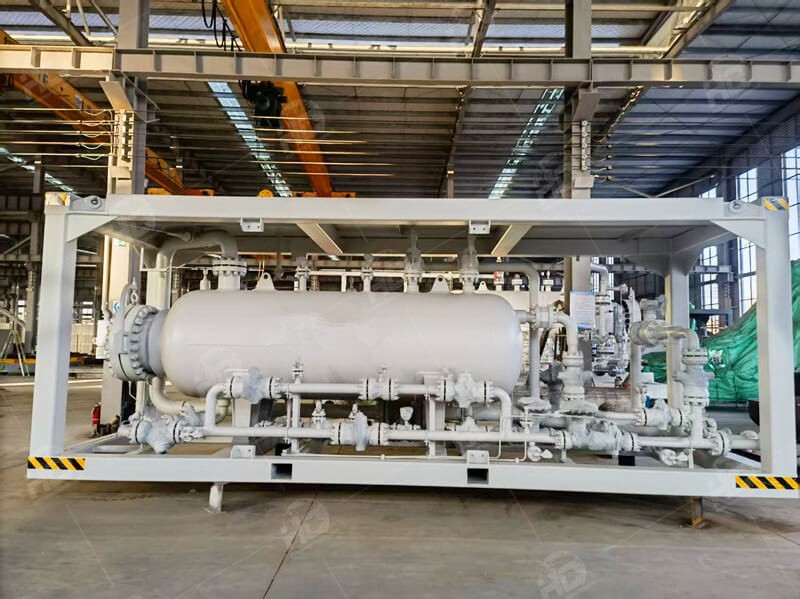
Let’s break down the logic behind it.
For most conventional oil wells, wellhead pressure typically falls somewhere between 500 and 2000 psi. When designing a separator, there is a basic principle that always applies: you don’t design right at the operating limit, you leave a margin. If the pressure rating is too low, gas cannot be effectively controlled and separation becomes unstable. On the other hand, if the pressure rating is too high, equipment cost increases, weight goes up, and fabrication becomes more complicated. Over time, the industry naturally converged on a practical range, roughly between 1000 and 1500 psi. And 1440 psi sits right at the upper end of that range — high enough to be reliable, but not excessive.
Another key point that is often overlooked is that 1440 psi is essentially equal to 100 bar. From an engineering perspective, this matters a lot. A clean, round number like 100 bar makes design calculations more straightforward, stress analysis clearer, and pressure classification easier to standardize. Many components such as valves, instruments, and flanges are selected based on this kind of pressure level. In regions like the Middle East and Africa, where the metric system is widely used, working with 100 bar is far more convenient than dealing with irregular psi values. So in many cases, what you see as 1440 psi is simply the practical expression of a 100 bar system.
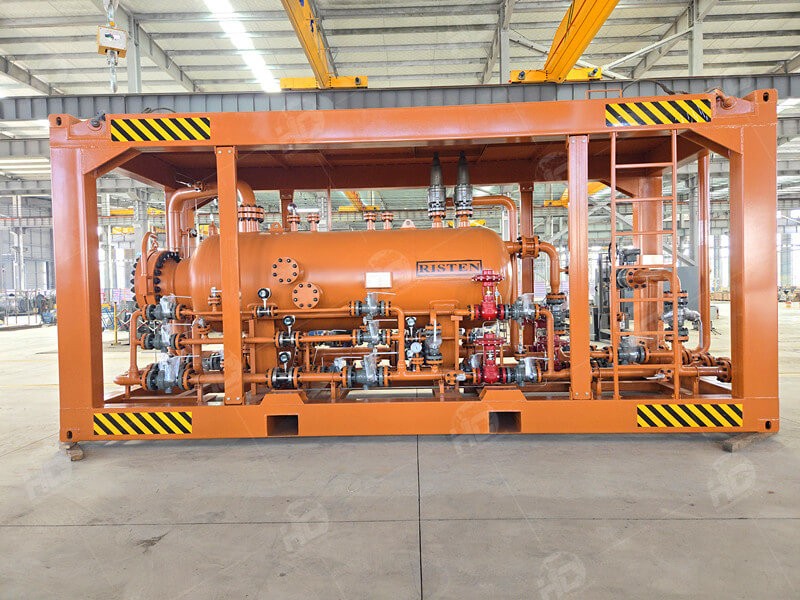
In real field operations, separators are not designed for extreme cases, but for versatility. A 1440 psi separator can handle most conventional well testing scenarios, typical gas-liquid separation conditions, and wells with moderate gas-oil ratios. At the same time, it allows gas expansion to remain controlled and gives liquids enough residence time inside the vessel, which helps maintain stable separation performance. That’s why in many projects, 1440 psi becomes the default choice — not because it is the highest, but because it consistently works.
Once you move beyond this level, things start to change quite noticeably. Increasing the pressure rating to 2000 psi or even 3000 psi is not just a small adjustment. Wall thickness increases significantly, overall weight rises, welding and inspection requirements become stricter, and manufacturing costs go up accordingly. From a fabrication and transportation standpoint, it becomes a completely different category of equipment. In contrast, 1440 psi sits at a very practical point where the strength is sufficient, while the equipment is still manageable in terms of weight, cost, and delivery. This is especially important for skid-mounted units that need to be transported and installed quickly in the field.
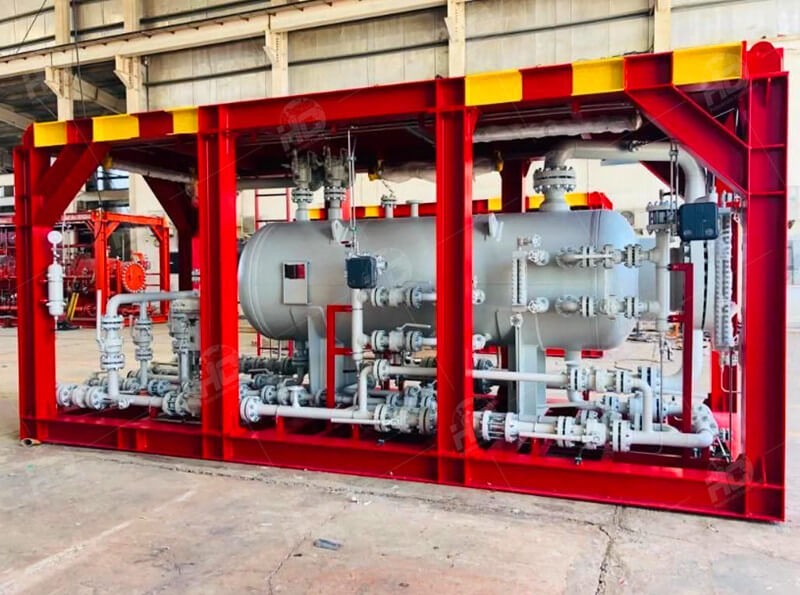
There is also a very practical reason behind its widespread use: once a certain pressure level has been proven across a large number of projects, it naturally becomes the industry’s default. Designs can be reused, engineering becomes more standardized, supply chains are well established, and clients are more comfortable selecting a configuration that has already been widely applied. Unless there is a specific reason to go higher, most projects will simply stay with 1440 psi.
In the end, 1440 psi is not the highest option, but it is often the most reasonable one. It provides enough performance for the majority of applications, while keeping cost, weight, and manufacturability under control — and that’s exactly why it has become the most commonly used pressure rating in oilfield separators.