
Cyclonic Desander vs. Sand Filter: What Is the Difference?
Sand and solid particles in oil and gas well fluids can cause erosion, blockage, and premature wear in downstream equipment. Removing these solids at an appropriate point in the production or well testing process is therefore an important part of sand management.
A cyclonic desander and a sand filter are two common solutions for removing sand from well fluids. Both are used in high-pressure oilfield applications, but they work in different ways and have different operating requirements.
Understanding these differences helps operators and equipment buyers select a suitable sand removal system based on well conditions, flow rate, particle characteristics, and maintenance requirements.
1.How Does a Cyclonic Desander Work?
A cyclonic desander uses centrifugal force to separate sand and other solid particles from the fluid stream. It does not rely on a filter screen or filter media to capture particles.
When the well fluid enters the cyclone liner, the internal flow path creates a swirling motion. Centrifugal force drives the denser solid particles toward the outer wall of the liner, while the lighter fluid moves toward the central flow region.
The separated solids are directed into a collection section or sand accumulator, while the treated fluid exits the desander.
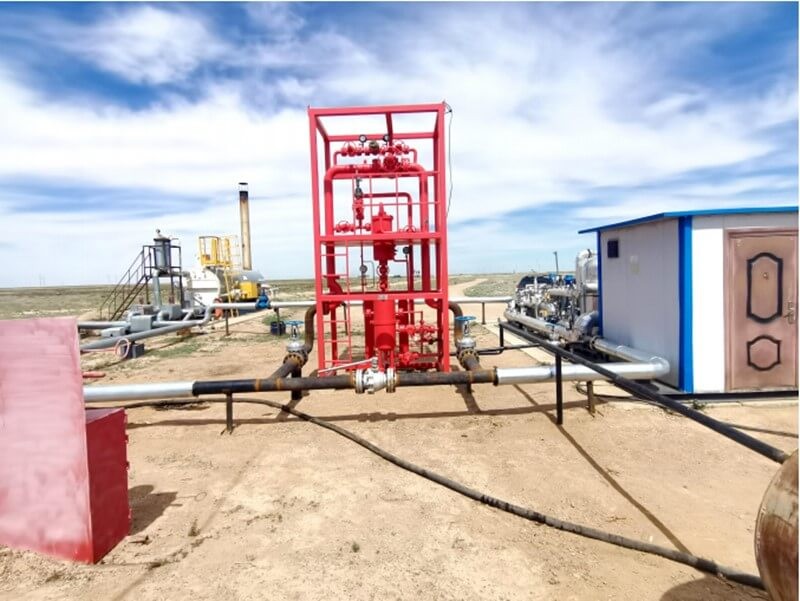
A cyclonic desander is commonly installed downstream of the wellhead and upstream of equipment such as choke manifolds and test separators. Removing sand at this stage can help reduce erosion and wear in downstream equipment.
Its separation performance depends on several factors, including flow rate, pressure drop, fluid properties, particle size and density, and cyclone liner design. The operating conditions must therefore be considered when selecting the equipment.
2.How Does a Dual Pot Sand Filter Work?
Unlike a cyclonic desander, a sand filter uses a physical filter element to retain solid particles.
In a dual pot sand filter system, two filter vessels are installed on a common skid. Each vessel contains a filter element, usually with a selected screen or mesh size according to the required filtration performance.
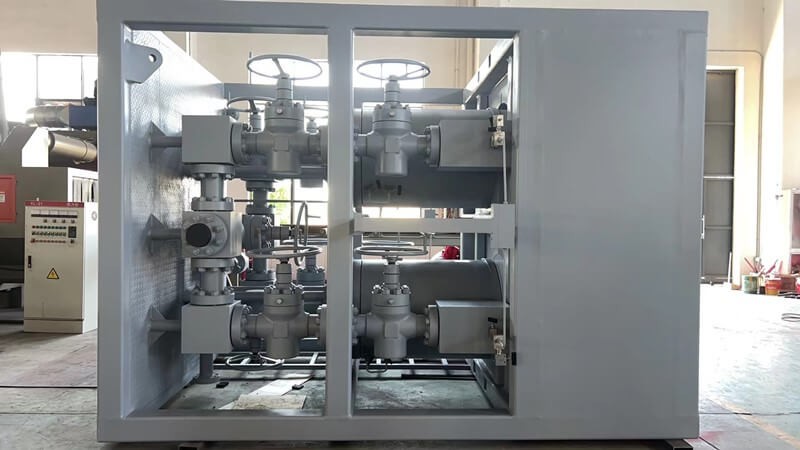
Well fluid passes through the filter element, and sand and other solid particles are retained on the screen. The filtered fluid then flows out of the vessel.
One important feature of the dual pot arrangement is that one vessel can be isolated for cleaning or backwashing while the other remains in service, provided the system is designed and operated for this switching arrangement.
This helps reduce equipment downtime during sand removal operations. The filter elements can also be inspected, cleaned, or replaced when required.
For example, HC Petroleum's Wellhead Dual Pot Sand Filter uses two filter vessels with isolation valves and a bypass arrangement. The filter elements can be selected according to the required filtration size and operating conditions.
3.Cyclonic Desander vs. Sand Filter: Key Differences
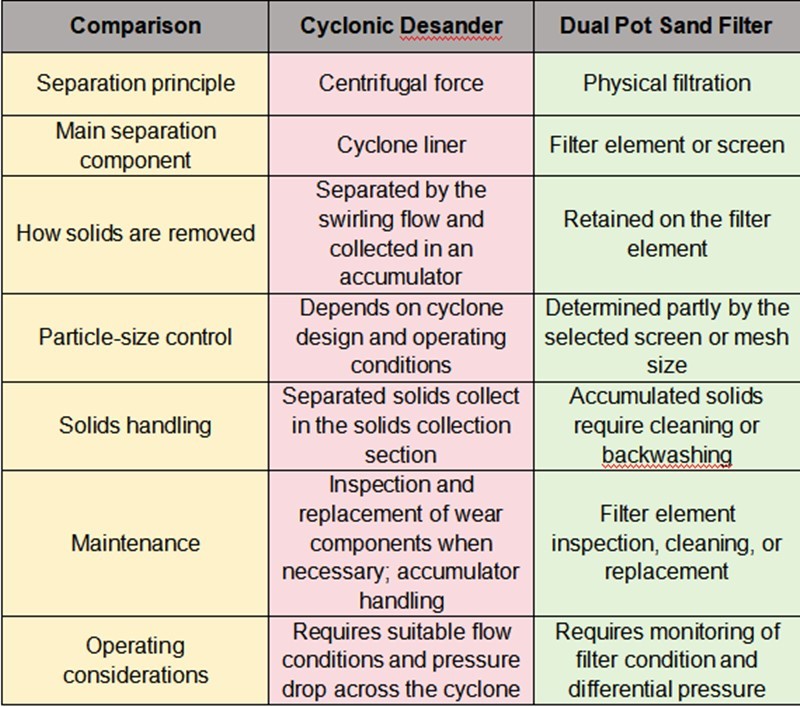
Although both systems remove sand from well fluids, their separation mechanisms and operating characteristics are different.
The main difference is straightforward: a cyclonic desander separates solids through centrifugal force, while a sand filter physically captures particles using a filter element.
Neither technology is suitable for every well condition. The selection should be based on the actual process requirements rather than the equipment name alone.