





This is a question that comes up quite often. The answer cannot simply be “yes” or “no.” The key is to look at the specific design conditions.
If the design pressure, design temperature, processing capacity, separation performance, material requirements, continuous operating conditions, and other factors of the equipment can all meet the requirements of the production system, then in theory, its suitability should be evaluated based on the specific operating conditions.
However, if a test separator is originally designed for short-term single-well testing conditions, using it directly for long-term continuous production would require reconsideration of its processing capacity, operating cycle, control system, and compatibility with the overall production process.
The same applies in reverse.
Although a production separator is capable of separating oil, gas, and water, if it is to be used for single-well testing, requirements related to metering, testing procedures, and switching between different well conditions also need to be considered.
Therefore, whether the two types of equipment can replace each other cannot be determined simply by looking at whether they can both separate oil, gas, and water. The overall process and design conditions need to be considered.
What is the fundamental difference between a test separator and a production separator?
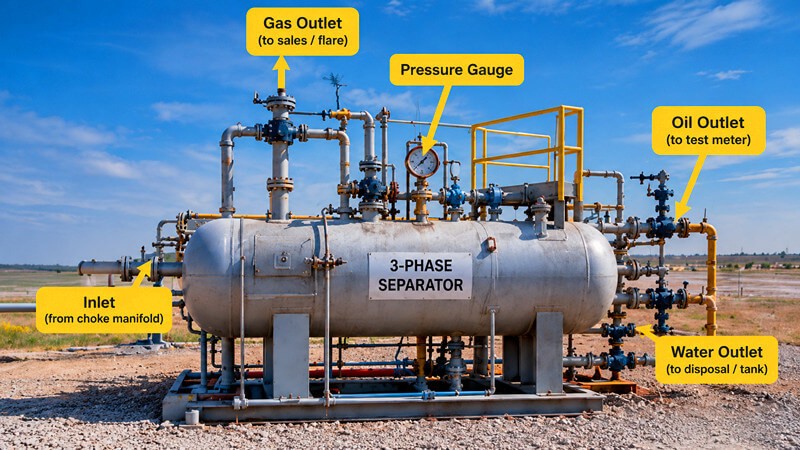
A Test Separator is mainly used for oil and gas well testing. Before a new well is put into production, or when the actual production capacity of an individual well needs to be evaluated during production, the well is usually connected separately to a surface well testing system to separate and measure the oil, gas, and water coming from the wellhead.
In this process, the test separator is one of the core pieces of equipment in the well testing system.
The test separator separates the mixed fluid coming from the wellhead into gas, oil, and water phases, which can then be measured separately to obtain important production data for the well.
For example:
What is the oil production rate?
What is the gas production rate?
What is the water production rate?
What is the gas-oil ratio?
What is the water cut?
What are the wellhead pressure, temperature, and production conditions?
It typically serves single-well testing rather than the long-term, stable production of an entire oilfield.
The main role of a Production Separator is different. Once oil and gas wells enter the normal production stage, fluids from multiple wells enter the gathering and production system.
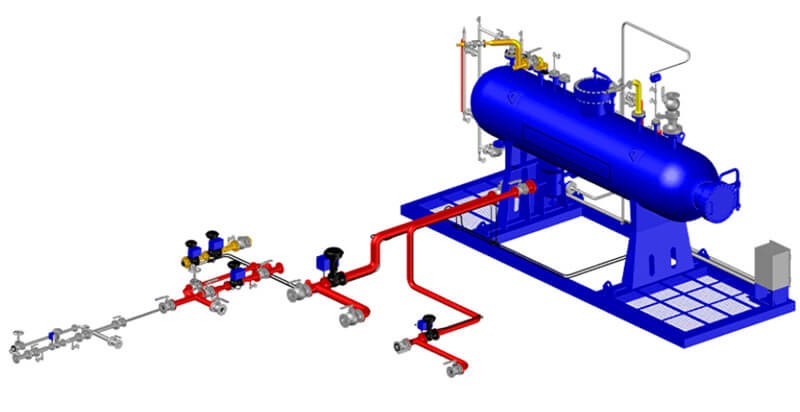
The crude oil, natural gas, and water coming from the wellhead cannot simply enter downstream equipment as a mixed stream. They need to be separated so that the different phases can be sent to subsequent processing, storage, or export systems.
This is where a production separator is used. It is primarily designed to handle production fluids continuously and reliably over the long term.
For example:
The oil phase is sent to the crude oil treatment or storage system;
The gas phase is sent to the natural gas processing, compression, or export system;
The water phase is sent to the produced water treatment or reinjection system.
Therefore, a production separator is typically part of the long-term production facilities of an oil and gas field and is required to operate continuously for extended periods.
To put it simply, a test separator answers the question: How much can this well produce? A production separator addresses the question: How can the oil, gas, and water be processed and transported reliably? This is also the most fundamental difference between the two types of equipment.
A test separator focuses more on single-well evaluation and production data acquisition, while a production separator focuses more on long-term production and oil and gas processing.
-
2026 / 08 / 13
 Dual Pot Sand Filter Designed and Manufactured for an Oman Oil & Gas Project
 -
2026 / 08 / 07
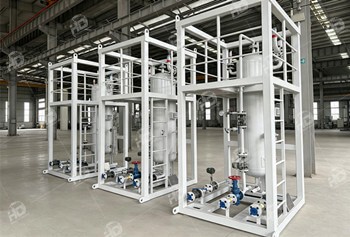 Three Vertical Three-Phase Separators Completed for Oil & Gas Project by HC Petroleum
 -
2026 / 07 / 24
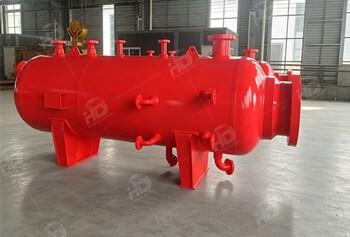 Two 1440 PSI Three-Phase Separators Completed for Nigeria Oil & Gas Project
- +86 158 6190 3617
